

By George Sass Jr.
Built to Go to Sea: A Palm Beach 65 in the Bass Strait
“Everyone hold on!” bellowed David Sampson from the helm.
The warning reached Anthony Daube secondhand. Off watch and tucked into the saloon’s aft-facing settee after a long stretch out of Sydney, he was in no position to respond.
As often happens offshore, we heard the wave before we felt it. A long, drawn-out, menacing roar of breaking white water, sounding very much like it had found its next victim in Palm Beach XII.
I turned just in time to see Anthony levitate off his perch.
There he was, suspended improbably above the saloon as the Palm Beach 65 waited to meet the trough of what could only be described as a five-meter wall. He floated long enough—I swear—to attempt something resembling an Irish line dance step, maybe even stretch a little, before gravity reasserted itself.
He came down hard, missing the settee and finding the sole instead.
A brief, shouted wellness check followed from our various braced positions. Anthony answered with a collective eye-roll, turned onto his side, and decided the sole—curled like a cat above the engines—was preferable for the remainder of his brief off-watch rest.
“I think I’ll wait on prepping dinner,” I offered.
Nobody argued.
And so the routine went as we pushed south from Sydney toward Hobart, shadowing the fleet in the 80th Rolex Sydney Hobart Yacht Race. No formal discussion was required during the initial hours of this passage; each of us independently concluded that limiting movement around the boat was simply good seamanship, particularly for those of us carrying more than fifty years of accumulated wear and tear on our bones.
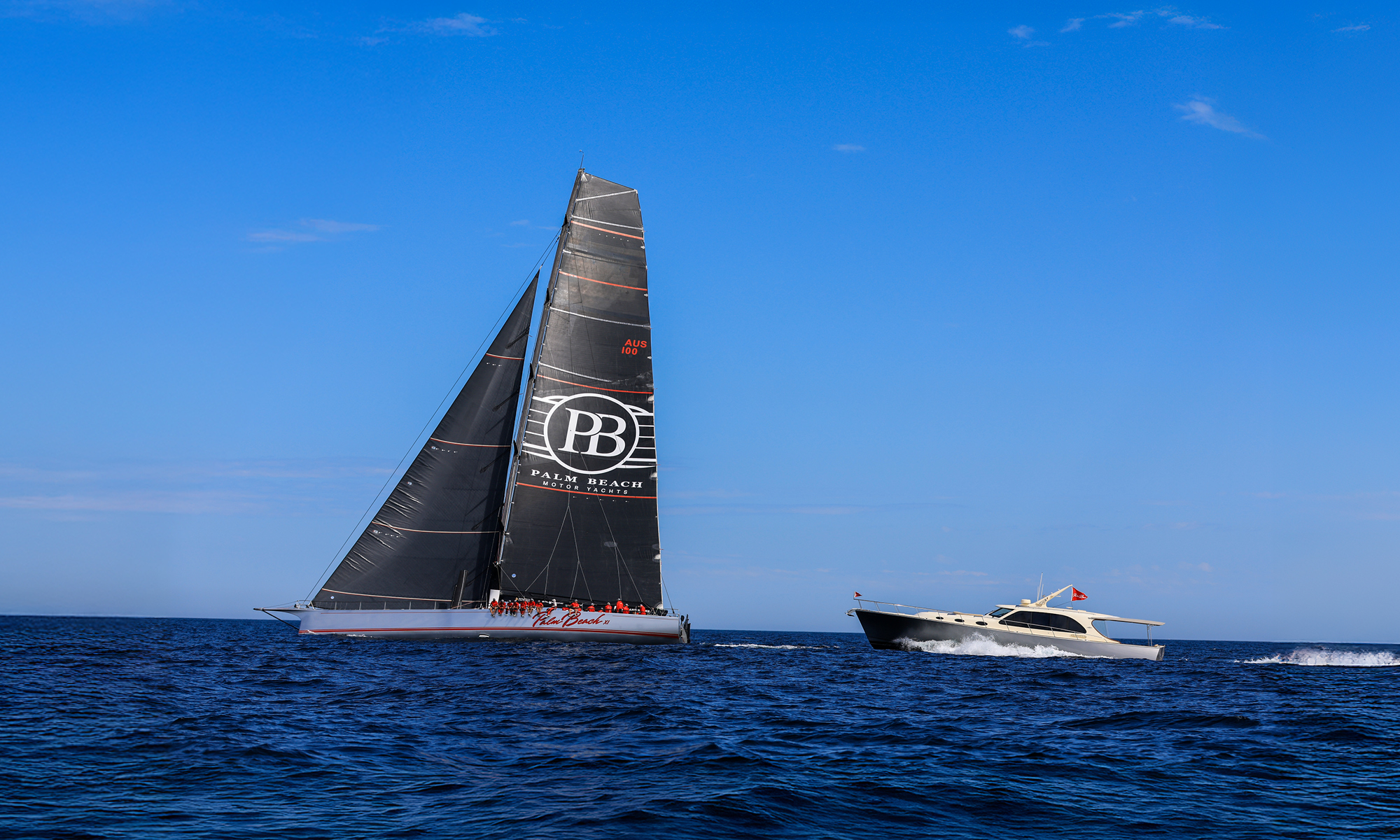
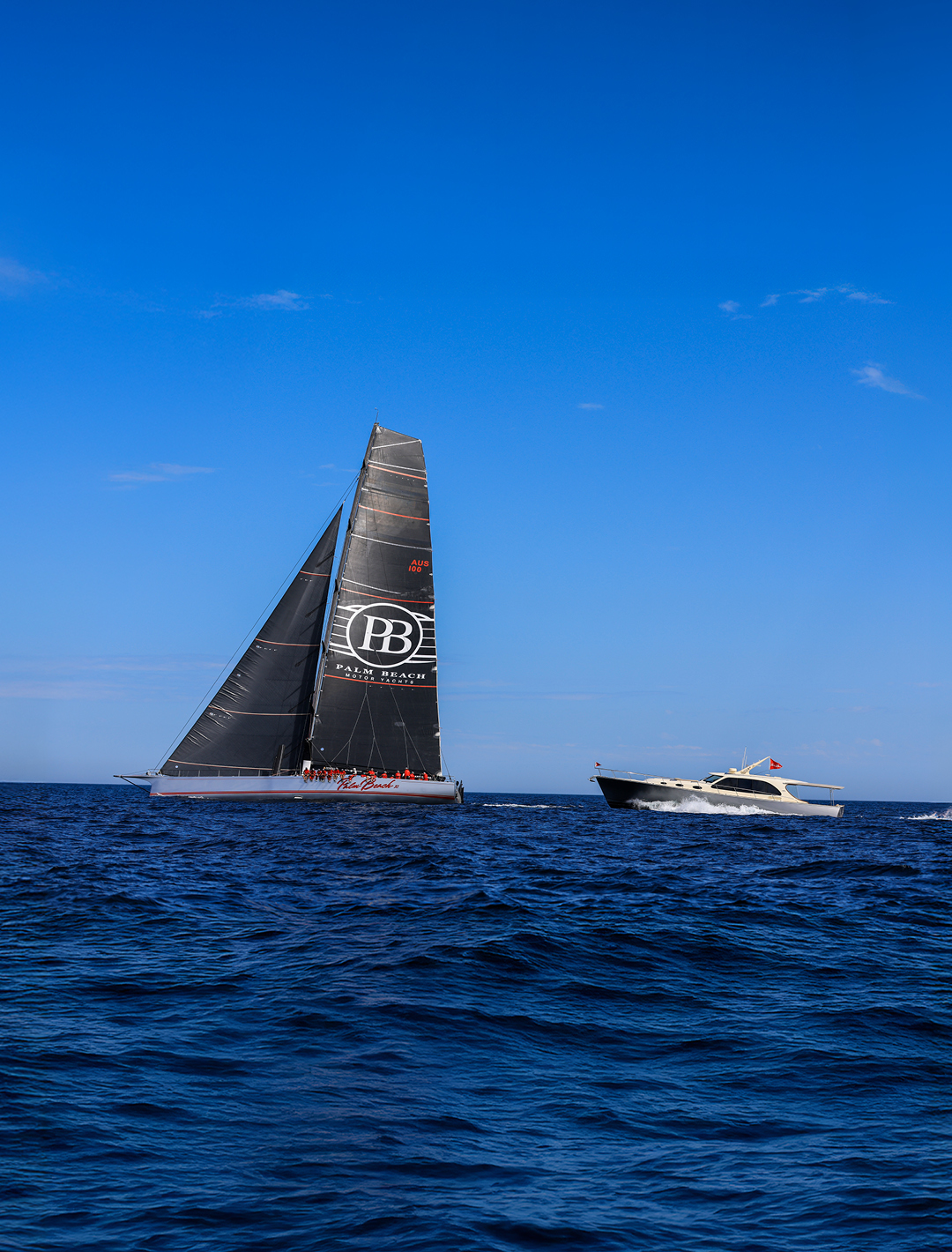
We hadn’t even made it through the first night when yachts began dropping out of the race. Accepting that we were not going to keep pace with Palm Beach founder and CEO Mark Richards—already twenty miles ahead aboard the Supermaxi Palm Beach XI—we reminded ourselves of an important distinction: we weren’t racing. We were here to see how a Palm Beach 65 handled one of the most notoriously unforgiving stretches of water in the world.
Which raised a very reasonable question. If conditions continued to deteriorate, wouldn’t it make sense to duck into Jervis Bay, drop the hook, grab a proper meal, and wait for the weather to do what the forecast promised it eventually would? The answer was a resounding yes.
This is where seamanship—and experience—comes into play. There were five of us aboard, and without anyone needing to say it out loud, we all understood that clinging to predetermined schedules offshore is rarely a good idea. John Bacon, a seasoned sailor and owner of a Grand Banks 60 (Palm Beach Motor Yachts’ sister brand), continued to model the weather and refine our strategy. He and David had spent enough time together offshore to develop an easy shorthand that only comes from sharing confined spaces in challenging conditions, and the mutual trust that follows.
So through a rational decision-making process helped along by a belly full of warm Bolognese, we decided to stay put in Jervis Bay, tidy the boat, and reassess at 0530.
Selfishly, I really wanted to complete the trip.
I suspect I was exposed to enough bottom-paint toxins in my youth working in boatyards to develop a fondness for this sort of thing. Maybe a therapist could uncover a deeper explanation beyond simple loss of brain cells. But I’ve always felt fortunate to go to sea and have experiences like this, even in foul weather. And after more than two decades aboard Palm Beach boats offshore, and testing 100s of boats as the editor of several US boating magazines, I already knew what we were documenting—that a Palm Beach is meant to go to sea.
Dawn came quickly. We poked our nose out and found the wave pattern more predictable, more forgiving. We continued south, and John and David suggested a stop in Eden, a coastal town of fewer than 3,000 people roughly 300 miles from Sydney. Here we would wait for another weather window to cross the Bass Strait.
After 24 hours in those conditions, we had used only 30 percent of our fuel. We averaged 17 knots on the first day, then closer to 19 knots toward Eden as the swell stretched out and the period lengthened.
“Let’s just see what happens” became the working strategy and we maintained Plans A, B, and C still close at hand. At some point we lost track of which plan we were actually following aboard Palm Beach XII, which is exactly how we ended up tied to the commercial wharf in Eden while a low with 30-knot gusts barreled through the Bass Strait south of our position.
Rounding out the crew was journalist Herb McCormick, whose sailing résumé matches his writing accolades. Cape Horn? Check. Sydney Hobart in the smallest entry at the time? Check. The Northwest Passage? Check. A delivery from Antarctica? Why not. So when even Herb, with all of his sea miles, looked a bit wide-eyed as we eased into Eden, we knew it was time to take the voyage more seriously.
So we did the only sensible thing once the boat was tied up and tidied—we went to the pub.
Back aboard Palm Beach XII after a pint of cold lager, we were coated with a little more hope and enthusiasm. Anthony fired up the transom grill and cooked steaks and sausages. While John confirmed the front would pass and leave a narrow window to sneak across the Bass Strait. We plotted our line to Hobart and slipped lines at 0100, aiming for a 2130 arrival.
It was bumpy around the headland, yet the Palm Beach 65 has an unusually easy motion in a head sea. The ride is soft and forgiving. I almost wish I didn’t have all those years on deep-V hulls ingrained in my muscle memory which give the instinctive brace for impact that never quite arrived. It simply isn’t part of the Palm Beach DNA.
We brought the cruise speed back up to 22 knots and settled into the rhythm of the run south. I spent time talking with Anthony about his own boats and the various adventures he and his wife Jenny have taken over the years. As a long-time Palm Beach Motor Yachts boatbuider, he has probably forgotten more about boat systems than I’ll ever know, and it left me inspired to get back to my own boat, currently tucked away in a yard in Maine.
As the wind subsided and the Palm Beach 65 cruised down Tasmania’s east coast, the scenery demanded our attention. John pointed out anchorages and secret coves as we passed, and somewhere along the way I added a circumnavigation of Tasmania to my growing list of future excuses to go to sea.
For a moment, one could be forgiven for forgetting this was work—that we were there for a reason. Then Starlink caught back up with us and reminded us to focus on the task at hand: making our way up the River Derwent to meet our friends aboard Palm Beach XI. A light wind allowed us to arrive about 90 minutes after she tied up in Hobart.
By the time we secured the lines, 33 boats had retired from the Rolex Sydney Hobart Yacht Race. The reasons varied, but most could be traced back to the same source—weather. Seasickness, broken rigging, damaged gear, lost liferafts. The race had lived up to its reputation.
Once the salt was washed off and Palm Beach XII was tied up at the Royal Tasmania Yacht Club, we finally had time to look at the numbers from our 633-nautical-mile passage. Even with the head seas, we averaged 19.2 knots. Total run time was 33 hours, and we arrived in Hobart with 16 percent of our fuel still in the tanks. Had we dialed the throttles back to around 12 knots, we likely would have spared Anthony his brief circus career and enjoyed an even more comfortable ride.
Not included in those figures were two overnight stops, one transom barbecue, and of course, a pub crawl.
Adventures, in my opinion, are a necessary part of life, like air. They’re good for your soul, and by extension, good for the people around you. A sure sign of a good one is when you’re sitting on a plane home, a little windburned and salt-stained, already thinking about the next time you’ll go to sea.
For me, I hope the next one is aboard a Palm Beach Motor Yacht. ■